October, 2026
Running drills? See Q4 Behnke + HDD package pricing →
You buy a 14,000-lb trailer for an 11,000-lb skid loader and figure you have 3,000 lb to spare. You don't. If the trailer itself weighs 4,000 lb, it can only carry about 10,000 — and you're overloaded before you leave the yard.
That math is where most trailer problems start, according to Jim Behnke, who co-founded Behnke Trailers in 1987 and has spent 39 years building equipment trailers. We sat down with Jim to talk about what an undersized or cheaply built trailer really costs a contractor: in parts, in fines, and in liability when something goes wrong on the road.
Here's what we learned.
A trailer's rating covers the trailer and its load. Subtract the trailer's own weight and you get what it can actually haul.
| Trailer rating | 14,000 lb |
| Trailer's own weight | – 4,000 lb |
| What it can really carry | 10,000 lb |
| Your skid loader | 11,000 lb — already 1,000 lb over |
Some of the load does shift onto your truck as tongue weight. But Behnke rates its trailers by what the axles can carry, because the manufacturer has no idea what truck you'll pull it with. "Can you add 2,000 pounds tongue weight? Can you add 1,000?" Jim asks. "We do not know."
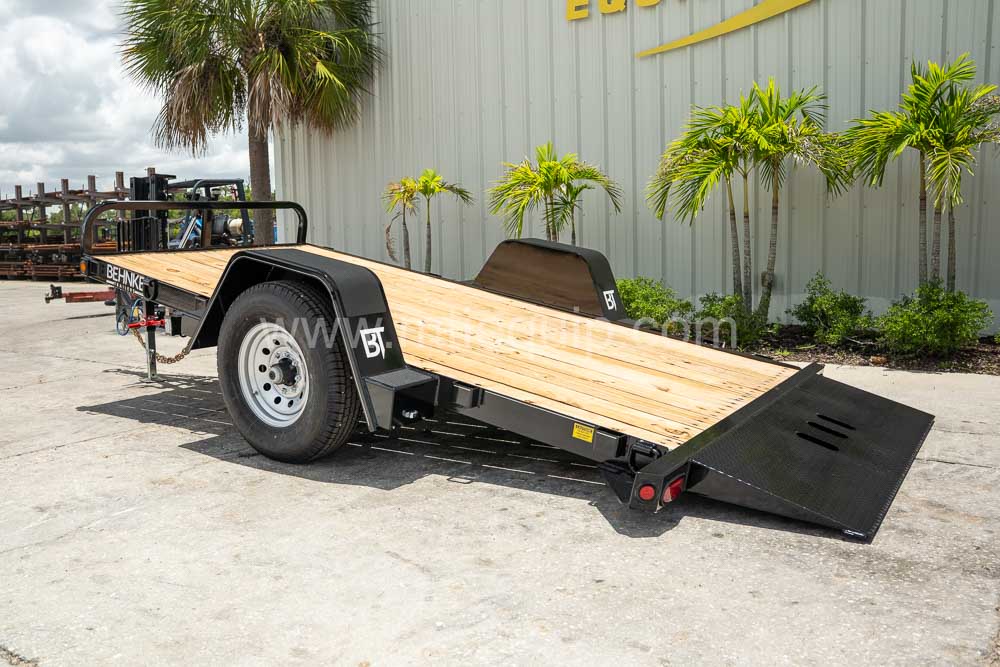
The second trap is the equipment's listed weight. Shipping weights are often measured with no fuel and sometimes no oil. Then add an extra bucket, attachments and a few hundred pounds of mud on the tracks.
Jim says this happens on demos all the time: "They'll say, 'Oh, this weighs 13,000.' And you put it on the scale, and it's 14.8." Eighty gallons of fuel adds up fast.
His rule of thumb: build 1,000–2,000 lb of margin into the trailer you buy. And plan for the next machine — "Next year they're gonna buy a skid loader that weighs 11,500."
Even a trailer that's legally within its rating sees forces well above its static weight. Engineers can't fully simulate it, so Jim builds for it.
His example: cross railroad tracks at 55 mph — "which you should slow down, but people don't" — and the trailer leaves the ground. When it lands, the force on the frame and axles is far more than the trailer and machine weigh.
He compares it to a trampoline. Stand still and you weigh 200 lb. Start bouncing and you're hitting the mat like you weigh 250. Potholes, bridge joints and rough job-site roads do the same thing to a trailer, every day.
Overloading doesn't usually break a trailer in one go. It wears it down in places nobody checks:
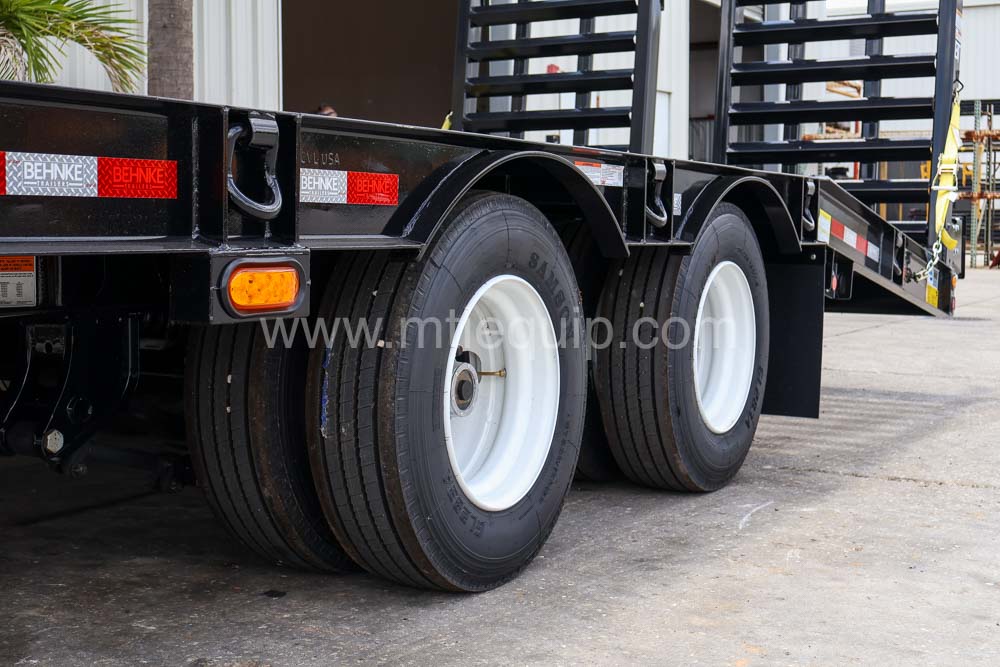
"A lot of people don't do maintenance on trailers," Jim says. "They just think the trailer's there and it's behind them." One small problem left alone turns into several expensive ones.
Two trailers can carry the same number on the sticker and very different hardware underneath.
Some builders sell an 8,000-lb axle that's really a 7,000-lb axle with heavier springs. The brake pads, magnets and bearings are still 7K-sized. "When people go to a dealership — 'Oh, it's got 8K axles.' Yeah, it does, but it really doesn't," Jim says. The trailer is rated for more weight than its brakes were built to stop.
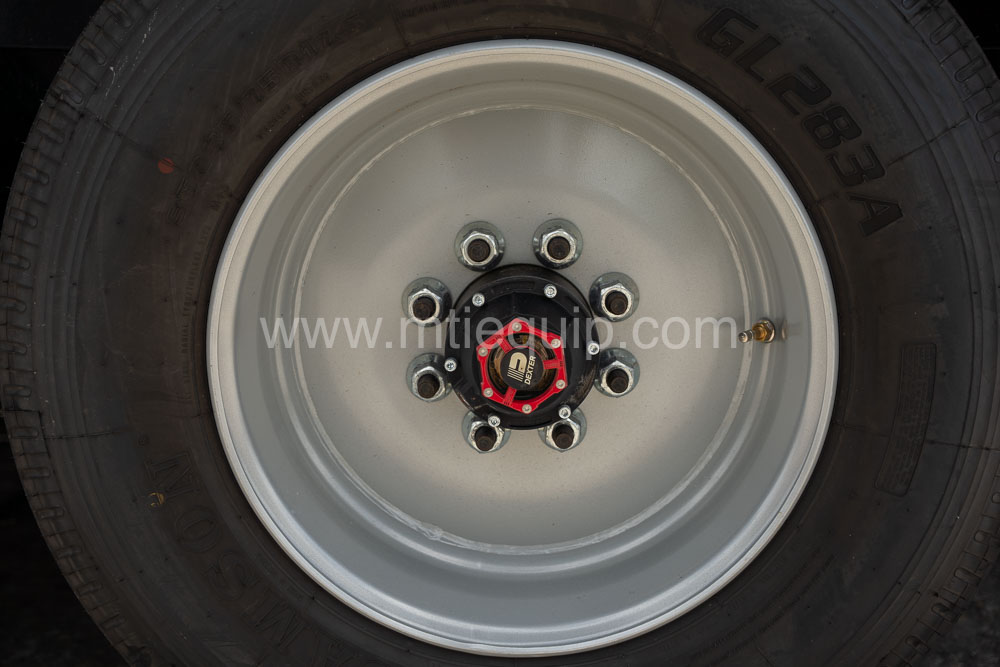
Jim estimates about 80% of the market rates a trailer with two 10,000-lb axles at 25,500 lb by counting the tongue weight they expect you'll carry. Behnke rates the same trailer at 20,000.
The problem is what the buyer hears. Take two 10K axles, subtract a 4,000-lb trailer, and real payload is about 16,000 lb. But the buyer sees 25,500 and loads 20,000 or more. "It might not be the first day, it might not be the second, it might be a year, but something's gonna happen."
The opposite mistake is just as costly. Buyers often ask to have a heavier trailer rated lower — for example a 20,000-lb trailer tagged at 12,900 — to keep the truck-and-trailer combination under 26,000 lb and avoid a CDL requirement.
Jim lays out what follows:
CDL rules depend on your combined weight ratings and your state. Check with your DOT or a licensing expert before you choose a rating to stay under a threshold.
As a business grows, the owner can't ride along with every driver. "Some guys will floor it as soon as the light changes," Jim says, "and the light turns yellow, and then they slam on the brakes." An overbuilt trailer is margin for the driving you can't control. Here's where a trailer at its limit turns into a claim.
The blowout on the shoulder. Tires that barely cover the load fail first. When one blows, the other tire on that side takes all the weight — and if the driver doesn't stop soon enough, it goes too. Now your employee is changing a tire on the traffic side of a busy highway. "Try changing that tire and be safe about it."
The intersection. A trailer should stop itself and its load. If its brakes are undersized — say 7K-class hardware under an 8K rating — the trailer pushes the truck instead. Add wet roads or worn truck tires, and it shoves the rig through the light. "Guess what happens? Somebody gets injured."
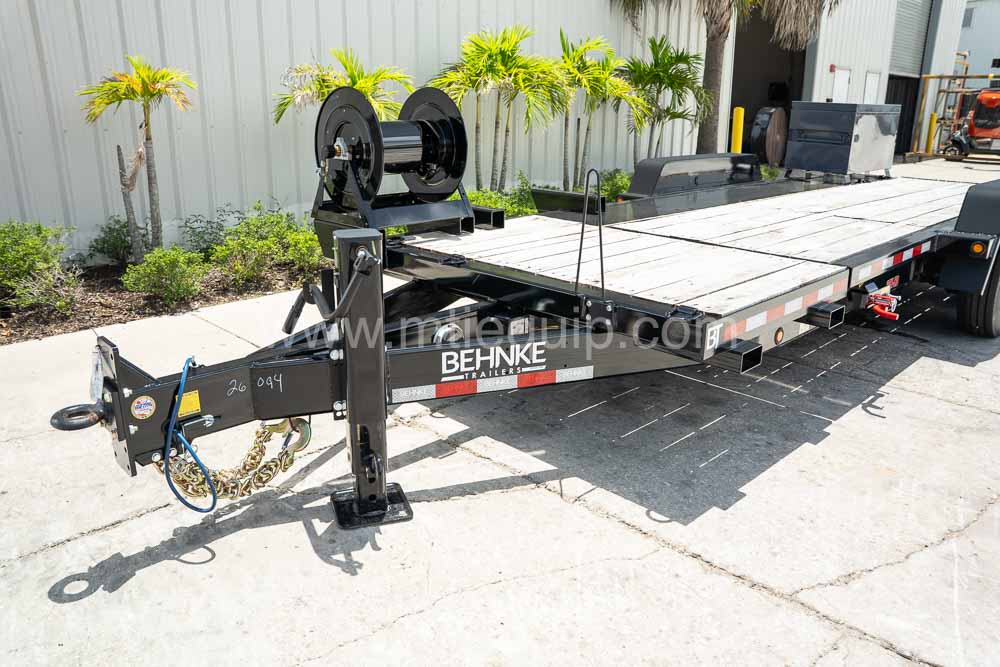
The hitch that lets go. Jim recalls a video of a trailer that broke its pintle hitch at 70 mph on the interstate. Only the safety chains kept it attached. Heavy enough chains, properly rated hooks and bolts, and a latched coupler are what stand between a scare and a disaster.
The investigation afterward. After a serious accident, Jim says the trailer is often impounded and checked: brakes, lights, then capacities. A rig loaded past its rating leaves you "no leg to stand on."
The stakes are real. Jim knows of a company whose overloaded trailers were involved in a crash that killed another driver — a claim he describes as "millions of dollars." Behnke carries product liability coverage that protects both the dealer and the end user. In 39 years it has been used once, Jim says, and the cause wasn't the trailer: a 2 5/16" coupler had been put on a 2" ball.
"Overbuilt" is easy to claim. Here's what it means at Behnke, in Jim's words and on the trailer.
| What they do | Why it matters |
|---|---|
| About 40% more steel than the design calculations call for | Covers the forces you can't simulate: rough roads, bouncing loads, the next, heavier machine |
| Extra gussets the software says aren't needed | "It's easier just to put that 40-cent piece of metal on there" than to see a frame crack |
| Dexter axles throughout, with roughly a 25% margin over their rating | An 8K axle should handle about 10K without bending or breaking |
| Molded modular wire harness, no splices except at the brakes | "Every day you hook up and you know your lights work" |
| Edges rounded and weld spatter ground off by hand | Paint and powder coat thin out on sharp edges — that's where rust starts, and where employees get cut |
| Steel shot-blasted before welding; seven-stage acid wash | Cleaner welds and better powder-coat adhesion |
| Holders for the harness plug and chain clips for the safety chains | Nothing drags on the pavement and wears through |
| Jack mounted further back, handle reaching the trailer's edge | More leverage, and no dented tailgate on your new truck |
| Four full-time engineers drawing custom setups | Attachment holders and racks built in, so nobody welds onto a new trailer |
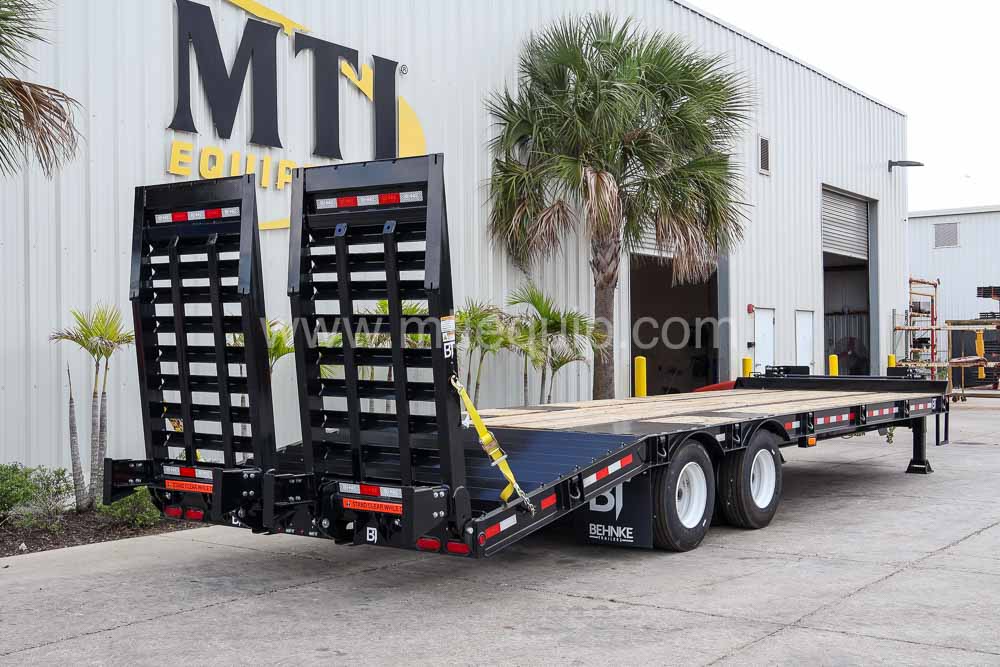
Jim's advice for comparing brands: go look in person. "I have so many dealers that'll put me side by side with other people." Buyers who picked the cheaper trailer over the phone often change their minds once they see the welds, the frame and the details next to each other.
Not every trailer injury happens on the highway. Crews slip climbing onto decks, get cut on sharp edges, or get hurt when a load shifts.
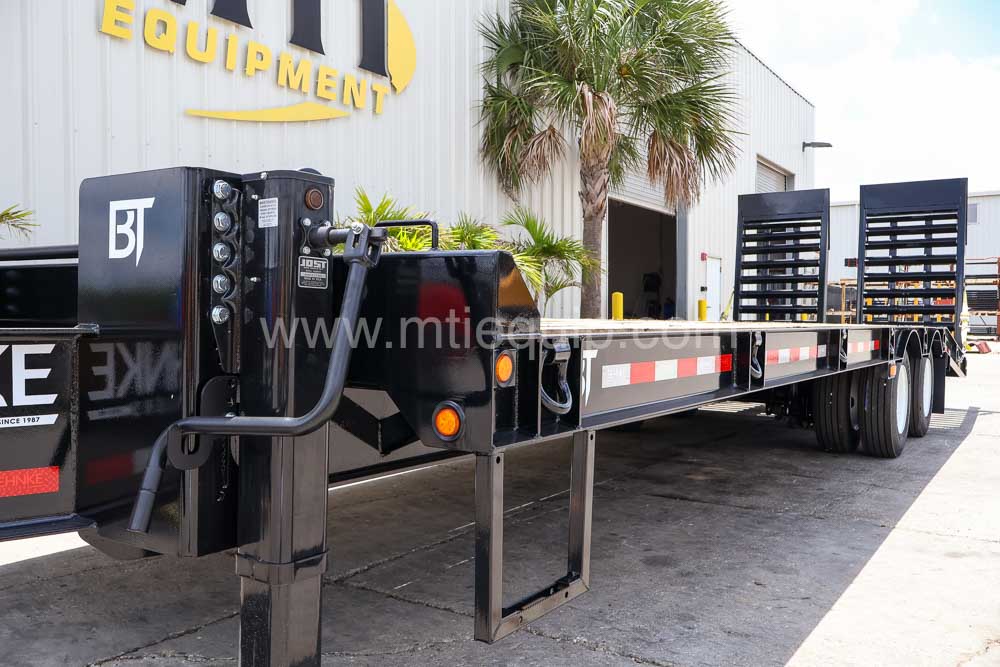
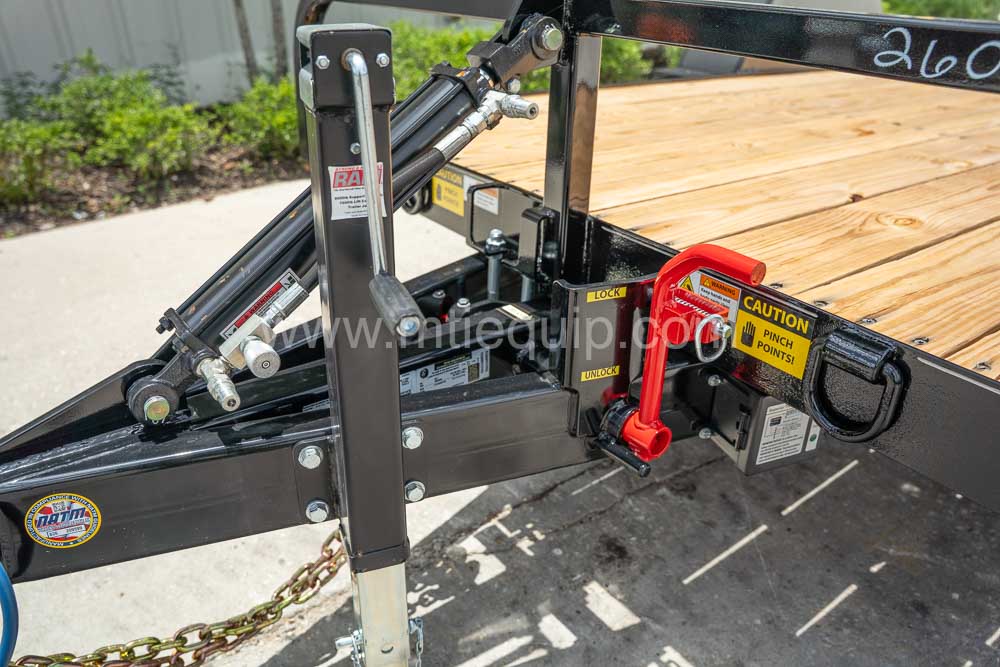
And there's retention. A trailer that works every morning — lights that light, ramps that lift easily — is one less reason for good operators to leave. "If you make it easy on them," Jim says, "they'll stick around."
The savings from a cheaper trailer are a few hundred to a few thousand dollars. One bad day on the road can cost far more. As Jim puts it: "If you were thinking about a 14,000, jump up to the 16 and spend a little extra money, because you know you're gonna overload it."
MTI Equipment now carries Behnke Trailers, including the Directional Drill Split Deck Tilt (24,000 GVW), the Super Duty Flatbed (40,000 GVW) and the 14' Tilt Bed (7,000 GVW). Through November 9, 2026, we're offering special pricing on new 2026 Behnke trailers and $5,000–$10,000 off complete HDD packages (drill, new trailer and support gear).
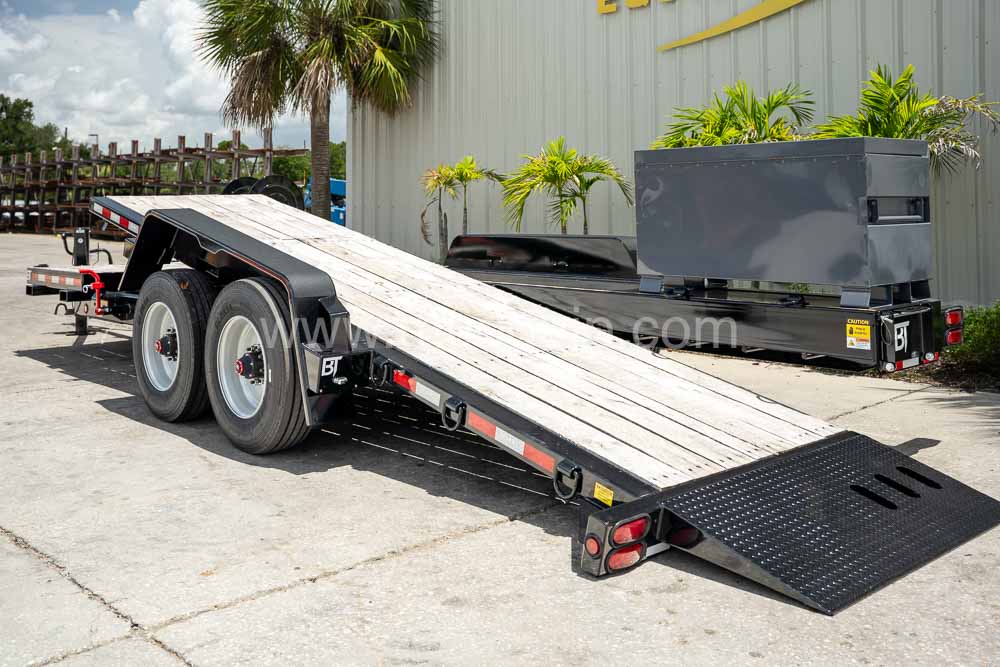
See the Q4 package deals → or call 941-401-1123.
SHARE
Got a question? Our support team will go the extra mile so you can have an easy and enjoyable experience with MTI.
Contact Us© 2026, MTI Equipment - All Rights Reserved.